INDIA AFRICA RELATIONS (5:20 PM):
Importance of Africa for India:
Geoeconomic importance:
- Africa is rich in mineral resources.
- Africa is home to emerging economies like Ethiopia, Senegal, South Africa, Kenya, etc.
- The Africa Continental FTA( AFC FTA) is in place already which is expected to push intra-Africa trade.
Geopolitical importance:
- It is a representative of the Global South.
- The African Union consists of 55 member countries.
- Africa is very important for Indian objectives like gaining permanent UNSc membership ( as the UN Charter amendment needs a 2/3rd majority).
Geostrategic Importance:
- It is situated close to two important choke points: the Suez Canal and Bab el Mandeb.
- It is important for Indian energy security as 15% of Indian crude comes from Africa.
- It is important for food security as Africa sees large private cultivations, especially for oil seeds.
- The region is vulnerable to many non-conventional threats like terrorism(Boko haram of Nigeria), piracy (Somalian coast), etc.
- Africa is important for counterbalancing China.
Evolution of India-Africa relations:
I. First Phase (1950s- 1960s):
- This phase saw Afro-Asia solidarity.
- India supported African struggles against colonialism, Apartheid in South Africa, etc.
- Africa saw good participation in the NAM.
- After the 1962 war with China, India was expecting support from Africa, but Africa maintained a neutral stance.
- This was also because even China had supported African anti-colonial struggles.
- India grew disenchanted with Africa.
II. Second Phase (1970s- 1980s):
- The Indian foreign policy was focused more on the Indian sub-continent.
- The Indian economy was also inward-looking.
- NAM started losing its relevance.
- Though India engaged with Africa on other multilateral forums like the UN General Assembly, G -77, etc..
III. Third Phase (1990 onwards):
- The breakup of the USSR reoriented the global power structures.
- India was caught up in domestic issues and its African outreach was limited.
- China started building strong relations with many African nations.
- Since the 2000s, India started to prioritize its relations with Africa.
- Just like in the case of Latin America, the private sector started to improve relations before the government (Flag following the Trade).
- India was also concerned about losing its footprint in Africa to China.
IV. Recent Phase:
- In 2008, India institutionalized its relationship with Africa by starting the India-Africa Forum summits.
- The first summit was held in New Delhi in 2010.
- The second summit 2011 in Ethiopia.
- The third summit was held in 2015 in New Delhi.
- The 4th summit was to be held in 2010 but it was postponed due to COVID.
FEATURES OF THE RECENT PHASE AFTER 2010 (5:45 PM):
- Institutionalization of relations through India-Africa Forum summits.
- Other countries like China, the USA, Japan, etc. have also institutionalized their relations with Africa.
- Trade & Investment:
- India is the third largest trade partner of Africa with bilateral trade of around $ 70 billion.
- Indis is the fifth largest investor in Africa with around $50 billion in investment.
Infrastructure:
- Dams and hydropower projects in Sudan and Rwanda.
- Sugar factories in Ethiopia.
- Technology parks in Mozambique, Swaziland, Lesotho, etc.
- Presidential palace in Ghana.
- National Assembly building in Gambia, etc.
Other features:
- India enumerated 10 guiding principles of India's engagement with Africa (such a mechanism was missing for Latin America).
- The engagement will be demand-driven, unconditional, and as per the demands of Africa.
- Between 2015 and 2020, there have been more than 35 African countries were visited by the level of President, Vice President, and Prime Minister.
- All African countries have been visited at least once at the ministerial level.
Diplomatic Engagement:
- India aims to open 18 new embassies in Africa; 9 have been opened.
- This will mean an Indian presence in 47/55 African countries.
- We also see individual states engaging with African nations.
- For example- Kerala- Ethiopia.
- Ethiopia seeks assistance regarding the Kudumbashree Self-Help-Group model and Kerala imports cashew nuts from Ethiopia.
- Cooperations like the International Solar Alliance, BRICS outreach summit, etc.
- African Union's inclusion in the G 20 recently.
China in Africa:
Pieces of evidence of Chinese presence in Africa:
- China has also institutionalized its relations through the establishment of the Forum of Africa-China Cooperation (FOCAC) in 2000.
- They promote their role in infrastructural and societal development in Africa.
- In June 2022, the first China- Horn of Africa Peace, Governance & Development Conference was held.
- Beijing appointed its first special envoy for the Horn of Africa.
- China has the 2030 Vision for Africa.
- China is the largest trading partner in Africa since 2009.
- China is engaged in many infrastructural projects:
- I. Nairobi-Mombassa railway link in Kenya.
- II. Bagomayo port in Tanzania.
- III. Djibouti -Ethiopia railway to provide Red Sea access to landlocked Ethiopian regions.
- China is the major foreign financial assistance provider to the East African countries.
- China gives condition-free loans( disregarding the political or human rights condition), despite higher interests.
The Horn of Africa-
- It consists of four countries, Ethiopia, Eritrea, and Djibouti.
- It is also referred to as the Somali peninsula.

Why Africa welcomes Chinese presence(1:50 PM):
- It acts as an alternative to the European powers.
- African governments that do not conform to the Western standards of democracy interact better with powers like China and Russia.
- Financial assistance from the West is often conditional on terms such as “respect for human lives”, and a strict study of the financial viability of projects.
- While Chinese loans charge relatively higher interest rates are free of such conditions and more forthcoming under the Chinese.
Reason for the growing Chinese presence in Africa:
- Apart from the economic reasons, the Chinese presence in Africa has a larger objective.
- It includes the aim to project itself as a regional leader and boost its international image.
- China presently is focussing on a multifaceted presence in the continent for the long run.
Differences in Indian and Chinese approaches in South America:
-
Chinese Approach Indian Approach China practices extractive foreign relations- mineral mining for its industries. Pushes capacity building or engagement with medium-small enterprises, and skill development. Elite-level wealth creation; has very little effect on common people. Indian companies have created local employment there. The final Chinese aim is to turn LAC into a source of raw materials and a destination for dumping its goods India aims for long-term and mutually beneficial engagement.
Connectivity:
- China seeks to augment the connectivity with and within Africa through BRI.
- Apart from this, India focuses on cross-border connectivity in Africa in three forms:
- Under SAGAR( Security and Growth for all in the region) and Sagarmala.
- Air connectivity through direct flights between cities of India and Africa.
- Digital connectivity, e-Vidyabharti,(Tele-Education) e- Arogyabharti( Tele-Medicine).
Asia Africa Growth Corridor(AAGC)/ India Japan Africa Growth Corridor (IJAGC):
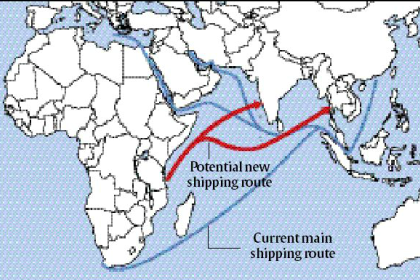
- It is a consultative initiative between three equal partners.
- The plan has been a non-starter and no project has been announced under it.
DEFENCE COOPERATION (6:15 PM):
- India’s defense cooperation with Africa is limited to issues like anti-piracy operations off the coast of Somalia.
- Deployment of Indian forces in United Nations Peace-Keeping Missions.
- India's cooperation is in the nature of capacity-building.
- China supports Africa’s military by providing artificial intelligence, military hardware, etc.
China- Horn of Africa Conference June 2022:
- China for the first time has clarified that it wants to play a role in the area of security in the region.
- China has also appointed a special envoy to the Horn of Africa.
- China has its first overseas military base in Djibouti.
- The USA speculates that China wishes to build military bases in Kenya and Tanzania as well.
- China had in 2018 launched the China- Africa Defense and Security Forum.
India’s comparative advantages in Africa:
- A shared colonial past.
- Indian unwavering support for the national liberation of African countries.
- Indian peacekeepers as well as the diaspora community respecting African traditions have integrated well into the African society.
- India is involved in various developmental projects such as the pan-Africa e-network.
- Africa has been the primary beneficiary of the Indian Technical and Economica Cooperation(ITEC) program.
- Team 9- India and 8 West African countries (Burkina Faso, Chad, Cote D’Ivoire, Equatorial Guinea, Ghana, Guinea Bissau, Mali, and Senegal), have all augmented Indian soft power.
- Indian diaspora is large in Africa and predates the British era in India, while Chinese migration has been a more recent phenomenon.
- Vaccine diplomacy during the Covid pandemic.
- Indian Ocean binds, rather than divides India and Africa.
- East African countries seek an Indian role in ensuring their coastal security.
Other reasons:
- India's expertise in IT, telecommunications, digital payments, and pharma industry is sought by Africa.
- Convergence of goals vis-a-vis global trade.
- Common goals- radicalization, climate change, skill training, etc.
- The ability of India to work with like-minded countries like Japan.
The way forward:
- Though Africa remains embroiled in civil turmoils, there is very little India can do regarding it.
- The Indian government outreach is limited only to the elite section of the Indian diaspora., this must be expanded for all sections.
- India must ensure effective timely delivery of the promised projects.
- Both India and Japan must work on achieving
- Sensitize the population and security forces against racism faced by African nationals.
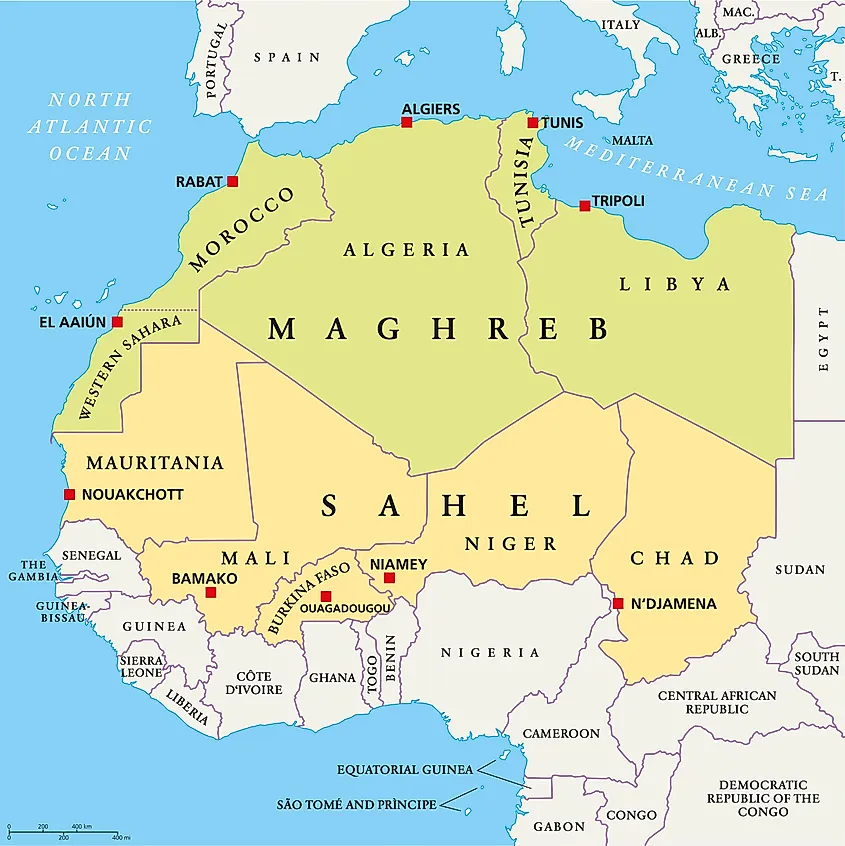
Regions in Africa:

BRICS: (6:50 PM):
- In 2001, Goldman Sachs economist Jim O. Neill coined the acronym BRIC.
- he believed that the combined GDP of Brazil, Russia, India, and China will surpass that of the industrialized countries by 2050.
- In 2006, the foreign ministers of these four countries met on the sidelines of the UNGA meeting.
- The first BRIC summit was held in 2009 in Yekaterinburg, Russia.
- In 2010, South Africa joined and the acronym was changed from BRIC to BRICS.
- At the 2014 Fortaleza Summit in Brazil, the decision to establish the New Development Bank (NDB)and Contingency Reserve Arrangement(CRA) was taken.
- This remains the most significant achievement of BRICS till now.
- The 2016 BRICS summit was held in Goa and India put forth the proposal of establishing a credit-rating agency, but it has not yet been materialized.
- In the 2017 summit in Xiamen China, the BRICS + format was established under which other developing countries were invited to participate in BRICS.
2023 Johannesberg Summit:
- It was the first in-person summit since 2019 and the COVID-19 pandemic.
- It was the first leader's summit since the Russia-Ukraine war.
- All the BRICS countries have chosen not to join the Western sanctions against Russia.
- In it, South Africa invited all 55 countries of the AU as a part of the BRICS-Africa outreach and 20 other countries from Asia-South America and SIDS under the BRICS + format.
- 6 new members are - Argentina, Ethiopia, Egypt, Saudi Arabia, UAE, and Iran.
- BRICS has a presence near major choke points like the Suez Canal, Strait of Hormuz, Bab-El Mandeb, etc.
-
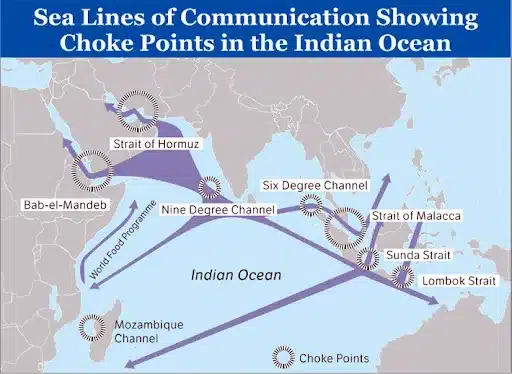
- The induction of four major countries from the Middle East and North Africa (MENA) region gives BRICS a major boost (Egypt, Saudi, UAE, and Iran).
- Their inclusion has been made possible due to the China-brokered peace deal between Iran and Saudi Arabia.
- With BRICS expansion, it now includes 6 of the world's top 10 energy suppliers.
- Inclusion of two African countries -Ethiopia and Egypt to BRICS.
- BRICS countries have agreed on guiding principles, standards, criteria, and procedures of the BRICS expansion process in the future.
- BRICS countries have committed themselves to strengthening the framework of mutually beneficial BRICS cooperation under the three pillars:
- I. Political & Security
- II. Economic & Financial.
- III. Culture & People-People cooperation.
- They have pushed for trading in local national currencies and not the US dollar.
- BRICS finance ministers and/or central bank governors have been tasked to present a report on payment mechanisms using local currencies by the next summit.
- BRICS support a comprehensive reform of the UN including the UNSC to make it more representative of developing countries.
EMERGING CHALLENGES FROM BRICS EXPANSION (7:30 PM):
- No clear membership criteria have been put out in the public domain.
- With the inclusion of countries like Iran, it strengthens its anti-West image.
- This could make the task of balancing BRICS, SCO on the one hand, and QUAD, IPEF on the other hand, difficult for India.
- Bilateral conflicts between BRICS members could make it more of an unwieldy body.
- For example- despite a recent reduction in bilateral tensions between Iran and Saudi Arabia, they are historical rivals competing for regional dominance in West Asia.
- Rivalry between Egypt and Ethiopia over the management of the Nile River.
- Dilution of its original purpose of the global institutions of governance mainly WTO and UN.
- Presently, the expansion of BRICS seems to be an effort led by China to create an alternative international order based on the Chinese vision.
- It is an effort of China and Russia to create an alternative to G 7.
- It is a geopolitical effort of Russia to reduce its international isolation due to sanctions after the Ukraine war and to co-opt the global south to keep its economy afloat.
- Difficulty in pushing intra-Brics trade due to sanctions on Russia and Iran.
- A threat to global multilateralism as the expansion of BRICS can be seen as an example of Minilateralism.
- It sees a smaller group of countries negotiating on a common agenda.
- The rise of bodies such as expanded BRICS, IPEF, etc. represents a wave of minilateralism.
Other challenges facing BRICS:
- Growing Chinese assertiveness and Russia-China partnership.
- Problems in South Africa increase its dependence on China.
- As China brokered the peace deal between Saudi Arabia and Iran, China will now have greater leverage over them.
- It is far from achieving its initial goal of reforms of global bodies of governance.
IBSA- India Brazil & South Africa:
- It was established in 2003 by the Brasilia Declaration.
- It was the brainchild of Yashwant Sinha.
- It was an India-led initiative between important countries of the global south from three different continents.
- All three have a democratic polity and commitment to a multi-cultural society.
Achievements of IBSA:
- Formation of IBSA fund for alleviation of hunger.
- All three members contribute $1 million per year to the fund.
- It has been utilized for development projects like the sports complex in Ramallah, Palestine.
China & IBSA:
- China wished to join the body and make it CHIBSA, but India and Brazil refused as China was not a democracy.
- IBSA was made redundant after South Africa joined BRIC in 2010 by China.
- No summit has been held after 2011, while BRICS held 15 summits in 14 years.
Significance of IBSA:
- Unlike BRICS & SCO, it does not have an anti-West image.
- It comprises only three countries with similar political systems and commitment to multiculturalism.
- So decision-making through consensus is easier.
BRICS v/s G7:
- (Expanded) BRICS account for 32% of the global GDP v/s 37% of the G7.
- (Expanded) BRICS represents 40% of the global population whereas G 7 represents just 10 %.
India's five-point Proposal at BRICS:
- The idea of the BRICS Space Consortium.
- All five BRICS countries are home to the world's most endangered big cats.
- PM Modi has sought the conservation of these big cats under the International Big Cat Alliance.
- Cooperation in skill mapping.
- In technology.
- Education
- The aim of the five-point proposal is to make BRICS "Future Ready".
The topics for the next class are G 20 & European Union.